Technical skill alone does not create success. Teams succeed when people understand each other, trust each other, and work toward a shared goal.
A diverse mix of personalities strengthens creativity, decision-making, and resilience—but only when led effectively.
“None of us is smart as all of us.” Kenneth H. Blanchard
Social Styles
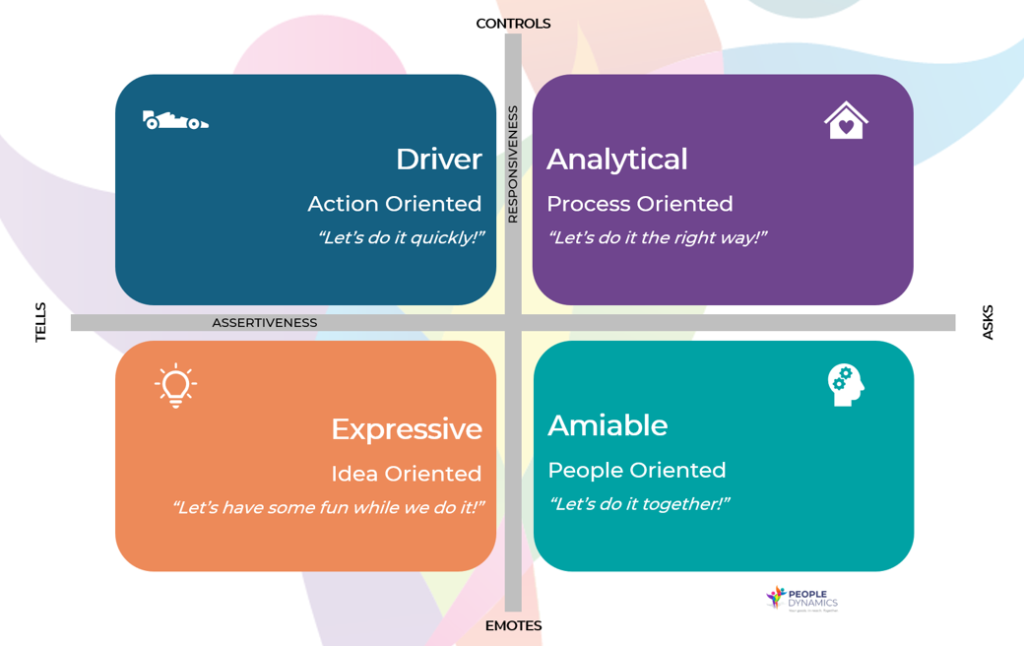
The Merrill and Reid Social Styles Model is a simple yet effective tool for understanding others and yourself. The model is based on the premise that people tend to be either more task-oriented (assertive) or people-oriented (responsive). These traits are plotted on a matrix:
IMPORTANT: This tool is a useful guide, not a rigid label. While everyone may display each style in different circumstances, most people have a default style. Avoid labelling individuals.
Here are the key characteristics of each social style:
🏎️ The Driver
Core traits: decisive, competitive, results-focused, fast-paced. Strengths: action, clarity, accountability, progress. Risks under pressure: impatience, bluntness, control behaviour.
People don’t automatically pitch up and work together. Based on the different social styles, it’s plain to see why. To achieve team goals a high functioning team takes a very specific development path. Through this process, employees begin to operate as a unit instead of a collection of individuals.
🌱 Forming Stage
What happens
Polite, cautious interactions
Unclear roles and expectations
Low trust, low conflict
Leader’s priority: Create clarity and psychological safety.
⛈️ Storming Stage
What happens
Conflict, disagreement, tension
Power struggles or cliques
Drop in performance
Critical insight: Storming is normal and necessary for growth.
Leader’s priority: Turn conflict into constructive dialogue.
✅ Norming Stage
What happens
Cooperation increases
Roles become clearer
Trust begins forming
Productivity stabilises
Leader’s priority: Strengthen shared ownership and accountability.
💪 Performing Stage
What happens
High trust and autonomy
Strong collaboration
Constructive conflict resolution
Focus on results and impact
Leader’s priority: Enable excellence and continuous improvement.
🔂 Whenever a new member joins, the team briefly returns to earlier stages.
Strong leaders accelerate the return to performing.
“Coming together is a beginning.
Keeping together is progress.
Working together is success.” Henry Ford
↙️ Next
The next two lessons explore your role in leading your team through its development phases.
Take the fun Merrill and Reid Social Styles Model quiz below to unlock Lesson 04.6.
We use cookies on our website to give you the most relevant experience by remembering your preferences and repeat visits. By clicking “Accept All”, you consent to the use of ALL the cookies. However, you may visit "Cookie Settings" to provide a controlled consent. Privacy Policy
This website uses cookies to improve your experience while you navigate through the website. Out of these, the cookies that are categorized as necessary are stored on your browser as they are essential for the working of basic functionalities of the website. We also use third-party cookies that help us analyze and understand how you use this website. These cookies will be stored in your browser only with your consent. You also have the option to opt-out of these cookies. But opting out of some of these cookies may affect your browsing experience.
Necessary cookies are absolutely essential for the website to function properly. These cookies ensure basic functionalities and security features of the website, anonymously.
Cookie
Duration
Description
cookielawinfo-checkbox-analytics
11 months
This cookie is set by GDPR Cookie Consent plugin. The cookie is used to store the user consent for the cookies in the category "Analytics".
cookielawinfo-checkbox-functional
11 months
The cookie is set by GDPR cookie consent to record the user consent for the cookies in the category "Functional".
cookielawinfo-checkbox-necessary
11 months
This cookie is set by GDPR Cookie Consent plugin. The cookies is used to store the user consent for the cookies in the category "Necessary".
cookielawinfo-checkbox-others
11 months
This cookie is set by GDPR Cookie Consent plugin. The cookie is used to store the user consent for the cookies in the category "Other.
cookielawinfo-checkbox-performance
11 months
This cookie is set by GDPR Cookie Consent plugin. The cookie is used to store the user consent for the cookies in the category "Performance".
viewed_cookie_policy
11 months
The cookie is set by the GDPR Cookie Consent plugin and is used to store whether or not user has consented to the use of cookies. It does not store any personal data.
Functional cookies help to perform certain functionalities like sharing the content of the website on social media platforms, collect feedbacks, and other third-party features.
Performance cookies are used to understand and analyze the key performance indexes of the website which helps in delivering a better user experience for the visitors.
Analytical cookies are used to understand how visitors interact with the website. These cookies help provide information on metrics the number of visitors, bounce rate, traffic source, etc.
Advertisement cookies are used to provide visitors with relevant ads and marketing campaigns. These cookies track visitors across websites and collect information to provide customized ads.