

How to Develop Effective and Efficient Systems
“In order for any business to succeed, it must first become a system
so that the business functions exactly the same way every time down to the last detail.”
Rick Harshaw
Operations vs Systems
You may have noticed frequent references to systems throughout this module.
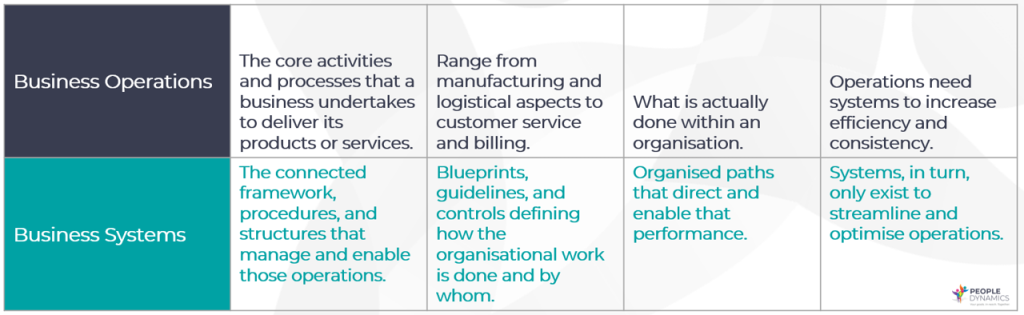
- Operations are what gets done.
- Systems are how it gets done — consistently, predictably, and at scale.
In simple terms:
☝️ Systems are the building blocks of reliable operations.
Without systems, businesses depend on:
- Memory
- Habit
- Individual heroics
With systems, businesses gain:
- Consistency
- Accountability
- Scalability
- Control
Intentional Direction
Imagine trying to navigate a complex maze without a map or compass.
Every turn is guesswork. Progress is slow. Frustration builds.
Running a business without operational systems feels exactly the same.
Operational systems become your:
- 🗺️Map — showing the most efficient route
- 🧭Compass — guiding consistent decisions
- 🏗️Framework — ensuring work flows smoothly every time
With systems in place, your business shifts from:
☝️ Reactive survival → Intentional operation
Well-designed systems connect:
- People
- Processes
- Technology
…so work happens smoothly, predictably, and at scale.
Why operational systems matter
Strong operational systems deliver measurable advantages:
∗Higher Productivity
Teams spend less time figuring things out and more time doing high-value work.
∗Consistency and Quality
Tasks are completed the same way every time, reducing errors and rework.
∗Accountability and Clarity
Roles, responsibilities, and expectations are clear and documented.
∗Scalability
Growth becomes manageable because systems absorb complexity as the business expands.
∗Better Decision-Making
Systems generate reliable data that reveals what is working and what needs improvement.
∗Improved Customer Experience
Smooth internal workflows lead to faster responses and dependable service.
Businesses Without Systems vs With Systems
✅ Without systems:
- Owner-dependent
- Repeated mistakes
- Inconsistent quality
- Limited growth
🚫 With systems:
- Delegation becomes possible
- Continuous improvement occurs
- Quality becomes predictable
- Scaling becomes sustainable
☝️ Systems turn effort into leverage.
SYSTEMS VS EVERYDAY TASKS
Many business activities feel small:
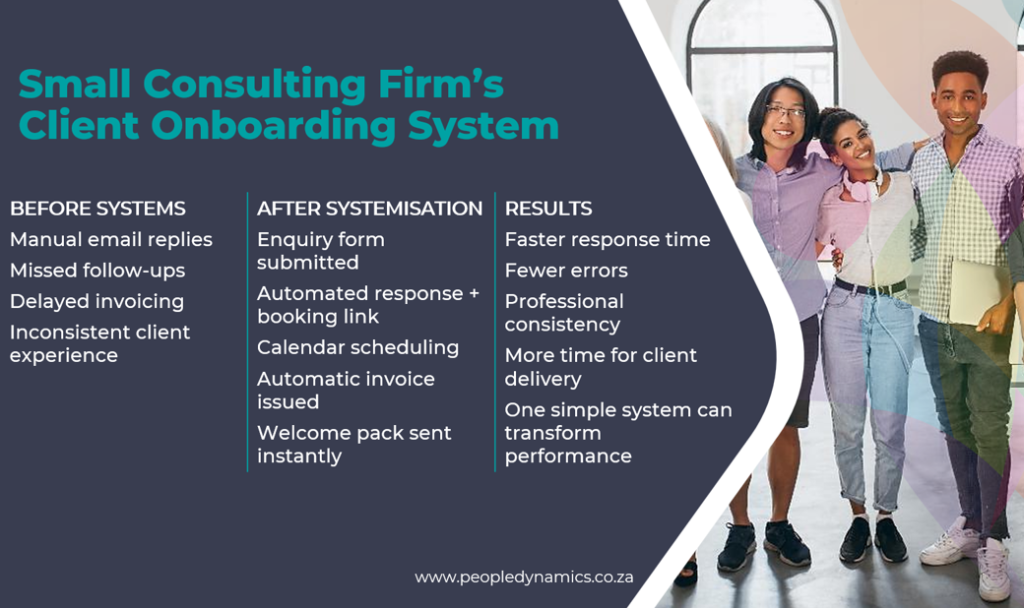
- Sending invoices
- Onboarding clients
- Scheduling staff
- Handling enquiries
Individually minor.
Collectively decisive.
These routine actions determine how:
- 💪Efficient
- ⚖️Compliant
- 💼Professional
- 🪜Scalable
…your business truly is.
When defined, documented, and improved,
these tasks evolve into reliable operational systems.
Practical steps to creating effective business operations systems
You do not need to systemise everything at once.
Start small and build momentum.
Step 1: Identify Recurring Activities
List tasks that repeat:
- Daily
- Weekly
- Monthly
These are your best system candidates.
Step 2: Map the Current Process
Document the task step-by-step:
- Who performs it
- Which tools are used
- Where delays or errors occur
You cannot improve what you cannot see.
Step 3: Simplify and Improve
Remove:
- Unnecessary steps
- Excess handovers
- Bottlenecks and delays
Ask:
❓What is the simplest way this could work?
Step 4: Standardise the Process
Define the best known method and document it clearly.
This becomes your:
📖 Standard Operating Procedure (SOP)
Consistency begins with clarity.
Step 5: Automate Where Possible
Use tools to handle:
- Data entry
- Scheduling
- Invoicing
- Reporting
Automation:
- Saves time
- Reduces errors
- Frees people for higher-value work
Step 6: Assign Ownership
Every system needs a clear owner responsible for:
- Maintenance
- Monitoring
- Updating
Without ownership, systems decay.
Step 7: Measure and Refine
Track key performance indicators for each system.
Use data to:
- Identify improvements
- Refine workflows
- Increase efficiency over time
☝️System development is continuous, not once-off.
Best practices for building strong systems
- Document processes clearly and keep them updated
- Use process mapping to uncover waste and inefficiency
- Create templates for common documents and reports
- Build analytics into systems from the start
- Gather employee feedback to improve workflows
- Ensure systems across departments are aligned and connected
System development is never complete.
As your business grows:
- Complexity increases
- Risks expand
- Opportunities multiply
Your systems must evolve at the same pace.
Businesses that rely on effort struggle to grow.
🌱Businesses that rely on systems grow with confidence.
↙️ Next
Complete the short quiz below to unlock the next lesson.